
What is BESS? (Battery Energy Storage System)
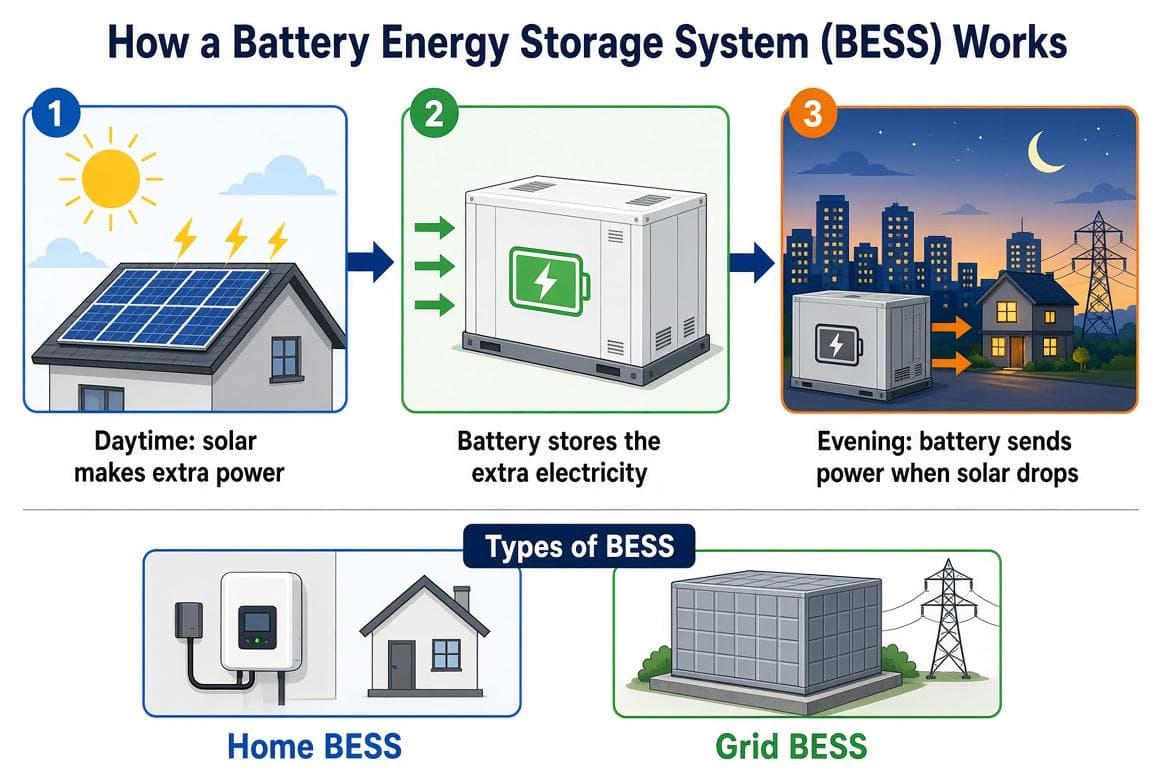
A Battery Energy Storage System stores electricity in batteries and sends it back when it is needed. Think of it as a large power bank for the grid — or a smaller one for a home. It charges when there is spare electricity (usually midday solar) and discharges in the evening, when demand jumps and solar falls. That helps keep the lights stable and makes solar and wind usable after sunset.
Why BESS matters for Pakistan
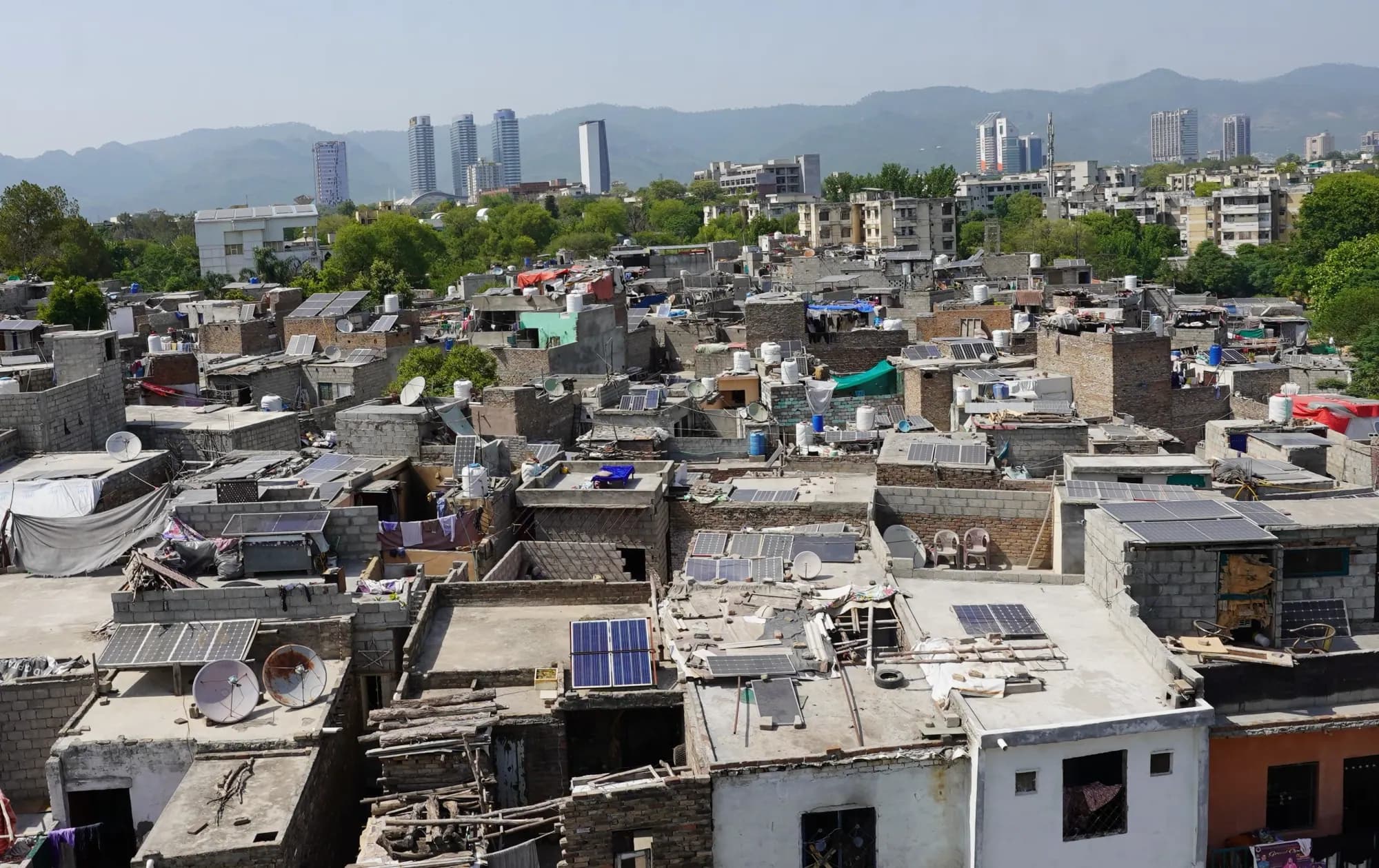
Pakistan is adding rooftop and utility solar faster than the grid was built to handle. Days can have too much solar. Evenings still need expensive thermal plants. That “duck curve” is why officials now treat storage as necessary, not optional.
What official planners say
- IGCEP (Indicative Generation Capacity Expansion Plan) 2025–35 — ISMO’s (Independent System and Market Operator) plan filed with NEPRA (National Electric Power Regulatory Authority) puts system-level BESS need at about 750 MWh (megawatt-hour) a year in 2025–27, rising toward 1,500 MWh from 2031 as solar grows. Storage is listed for fast response, balance, and stability.
- Power Minister Awais Leghari has told Parliament and later officials that utility-scale BESS is needed for intermittency, demand management and grid stability. In early September 2026 he also pushed distribution-level BESS pilots where solar is causing reverse power flow, plus transmission projects (including a Jhampir site tied to wind).
- The Power Division set up a BESS committee (convened by NGC/NTDC’s (National Grid Company) Managing Director) to decide where to put batteries, at what voltage, whether to use PPP or central buying, and how to line up Asian Development Bank, World Bank and GIZ (German development agency) support.
- ISMO asked NEPRA to require at least 10% firm BESS with solar/wind in the surplus-power auction, specifically for curtailment and the duck curve.
- ADB’s proposed project 60126-001 would put about 1,000 MW / 2,000 MWh on the transmission system (two ~500 MW / 1,000 MWh, 2-hour units) along the north–south corridor — among the largest ADB-backed grid batteries, and the first of that scale in this region. Status: proposed; feasibility still running.
- Households are already buying batteries. After the shift toward net billing, keeping solar for evening use pays more than exporting cheap daytime units. Renewables First, using customs/industry data, reports about 7.6 GWh of lithium-ion imports from 2018–2025, with most of that arriving in 2025, and a large residential share.
In one line: more solar without storage means more wasted daytime power and a harder evening peak. Storage turns that solar into usable evening electricity and helps the grid stay stable.
What is a Virtual Power Plant (VPP)?
A VPP is not a new power station. It is software that links many small things — rooftop solar, home and shop batteries, EV chargers, even flexible loads like ACs or tube wells — and runs them as one plant.
Example: thousands of home batteries charge at noon, then discharge together at 6–9 pm when the grid is tight. The operator sees one block of power, not 10,000 separate houses.
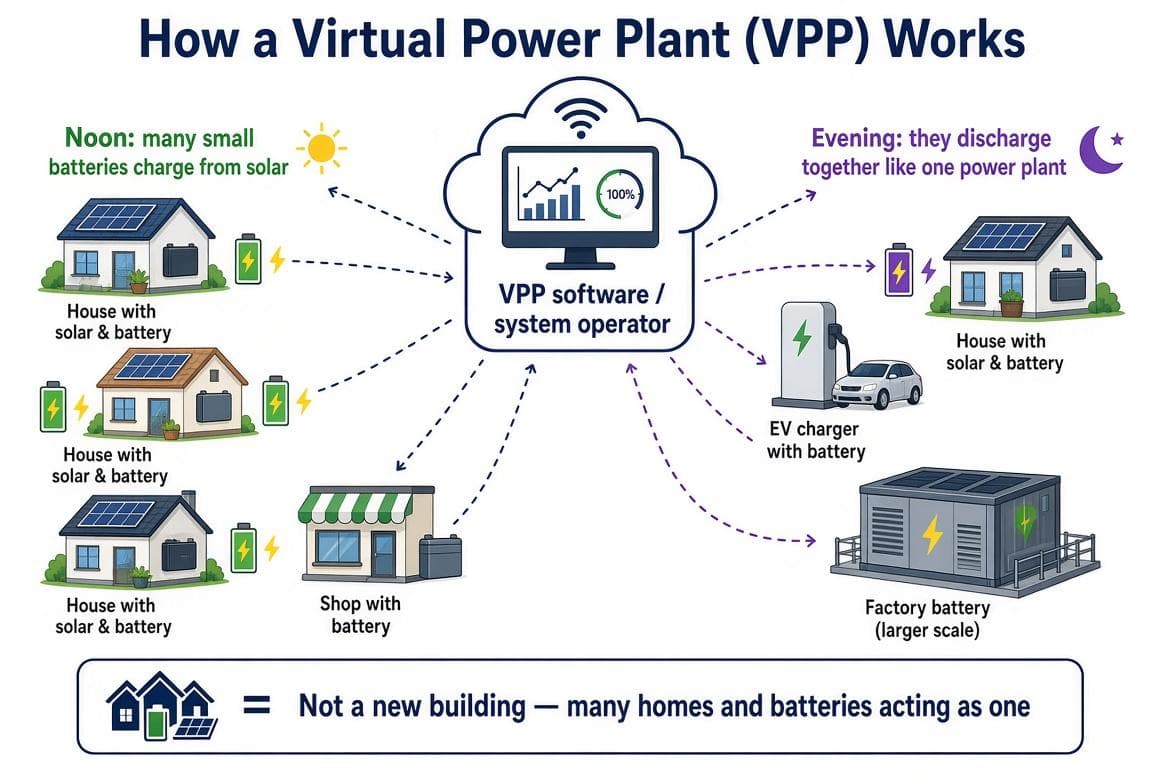
A Virtual Power Plant (VPP) is not a new building. It is software that links many small energy things and runs them together like one power plant.
What gets linked
- Homes with solar and a battery
- Shops with a battery
- EV chargers
- Sometimes a bigger factory battery
Each one is small. Together they can be large.
How it works, in two times of day
Noon
The sun is strong. Houses make more electricity than they need. The VPP tells those batteries: charge now. Extra solar goes into the batteries instead of flooding the grid.
Evening
The sun is gone. Everyone turns on lights, ACs, and cookers. The VPP tells those same batteries: discharge now. Many small batteries send power at the same time. To the grid it looks like one plant switching on.
The cloud in the middle of the picture is the control system. It sees who has spare power, who needs it, and sends the instructions.
Why “virtual”
There is no single chimney or dam. The “plant” exists only because software coordinates rooftops, batteries and chargers.
What that means for a household
Your battery can still run your house. In a VPP it can also help the grid at peak time — if rules and payments exist — instead of sitting unused after you have covered your own evening use.
Types of VPP
A VPP is still the same idea: software that groups many small energy assets and runs them as one plant. The “type” only says what is being grouped.
1. Supply-side VPP
Groups things that make or store power: rooftop solar, home batteries, factory batteries, small generators.
Job: send extra power to the grid when it is needed (especially evening).
2. Demand-side VPP
Groups things that use power and can wait a bit: ACs, heaters, tube wells, industrial machines.
Job: pause or shift that use at peak time so the grid is less stressed. No new power is made; demand is moved.
3. Mixed / hybrid VPP
The usual real-world type. Solar + batteries + EV chargers + flexible loads in one pool.
Job: charge at noon, cut or shift load at peak, discharge batteries in the evening.
4. Home / residential VPP
Many houses with solar and a small battery, like the left side of the picture.
Job: turn household storage into a shared evening plant.
5. Commercial and industrial VPP
Shops, factories, warehouses — the shop and factory battery in the picture.
Job: bigger batteries, more reliable response than one house.
6. EV VPP
Electric cars and chargers. Cars charge at midday; some can send a little power back later (vehicle-to-grid).
Job: use parked cars as extra batteries.
How a VPP helps Pakistan
| Problem today | What a VPP can do |
|---|---|
| Solar floods the grid at noon | Charge scattered batteries then |
| Evening peak needs imported fuel plants | Discharge those batteries instead |
| Net billing pushes people to leave the grid | Pay them to stay connected and help at peak |
| Big BESS is costly and slow to site | Use batteries people are already buying |
| DISCOs see rooftop solar only as lost sales | Treat solar + storage as a local reserve |
A VPP works with large BESS, not against it. Grid-scale batteries fix transmission and frequency. A VPP uses the batteries already in homes and factories. Together they cut fuel imports, ease evening ramps, and give consumers a reason to stay on the grid. Policy briefs (SDPI and others) and grid-modernisation notes already flag BESS + VPP pilots as the next step; Pakistan does not yet have a full national VPP market rule.
How the two fit
- BESS = the battery hardware (home, factory, or grid).
- VPP = the brain that coordinates many batteries and solar systems.
Pakistan needs both: official big batteries for the national grid, and a VPP so household storage helps everyone, not only the house that bought it.
Bottom line
Official planning (IGCEP), the Power Minister, the BESS committee, auction design, and ADB’s proposed 1 GW / 2 GWh project all say the same thing: solar is here; flexibility is the missing piece. BESS stores the extra sun. A VPP can turn Pakistan’s rooftops and home batteries into a shared evening power plant — if rules, meters and fair peak payments catch up.
References
- Mahadevan et al. (2025). doi.org
- NEPRA/ISMO, IGCEP 2025–35, s. 6.3. nepra.org.pk
- INP/WealthPK, 2 Sept 2026. inp.net.pk
- Business Recorder, 23 Apr 2026. brecorder.com
- Arab News, 2 Sept 2026. arabnews.pk
- Business Recorder, 27 Dec 2025. brecorder.com
- Dawn, 14 Jul 2026. dawn.com
- ADB Project 60126-001. adb.org
- Renewables First (2026). renewablesfirst.org
- Dawn, 24 Aug 2026. dawn.com
- Dawn, 12 Aug 2026. dawn.com
- CASS policy brief. casstt.com
- SDPI VPP brief. sdpi.org